
Written by Anne Swartz. Edited by Karin Luner.
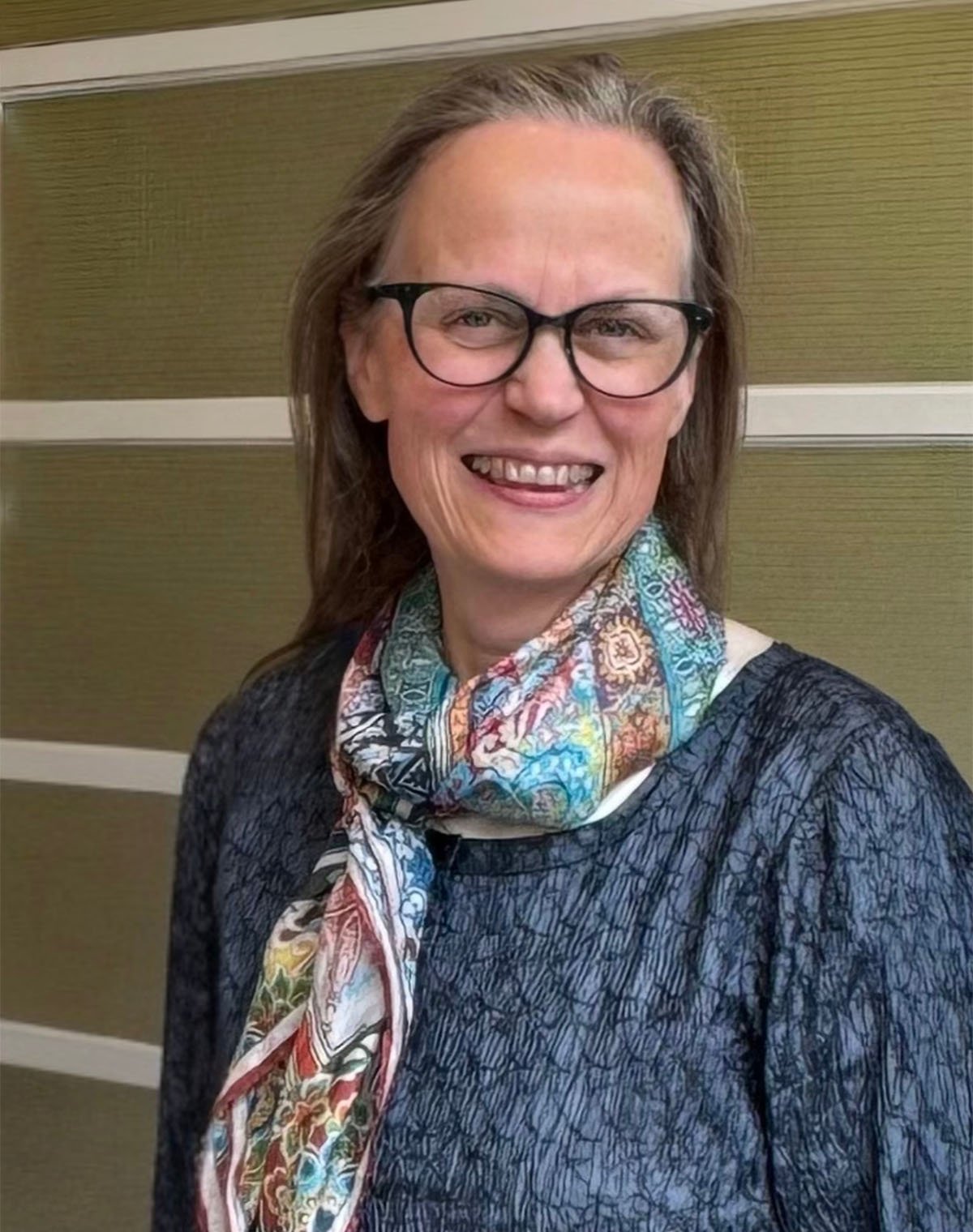
Anne Swartz is an art historian and professor of art history at the Savannah College of Art and Design, where she has taught since 1994. Her scholarship centers on feminist art, critical theory, and contemporary art, including art and technology and disability aesthetics. She is a scholar of Pattern and Decoration, the American art movement of the mid-70s to mid-80s. She curated Pattern and Decoration: An Ideal Vision in American Art, 1975-1985 at the Hudson River Museum in 2007 and 2008, and directed the two-part documentary Pattern and Decoration: Looking Beyond Formalism (Part I, 1998-1999, and Part II, 2018). She chaired the Honors Awards for the Women's Caucus for Art from 2006 to 2011. She was a Fulbright Scholar in Tokyo from 2002 to 2003.
More at anneswartzblog.org and on LinkedIn.
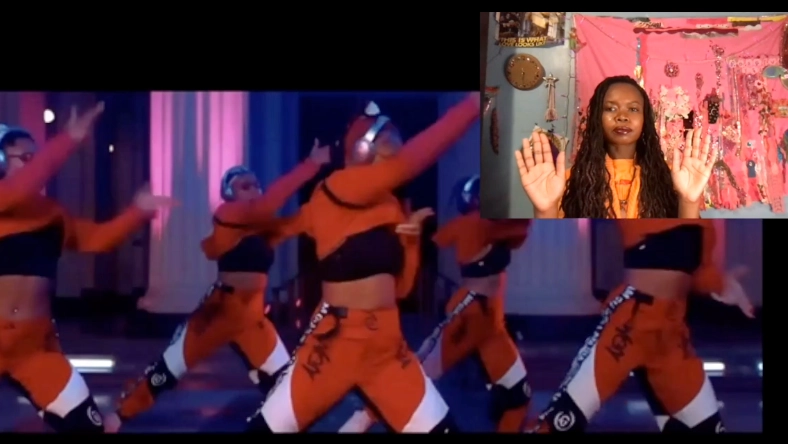
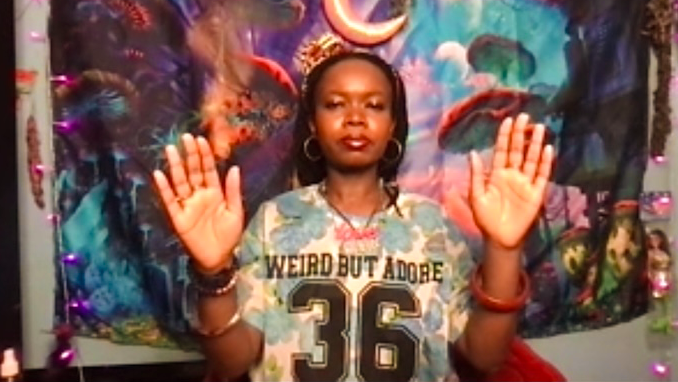
Banner image: Level Up Reiki with Ciara, Brooklyn Public Library (BPL) Creatives-In Residence Finale on Zoom, video still.
Damali Abrams, also known as the Glitter Priestess, approaches art as both a research practice and a form of healing. Working across collage, video, artist books, zines, and community-based projects, her recent work centers on Southeast Queens: its histories, its erasures, and its living cultural memory.
Abrams’s turn toward Queens is both personal and political. Having grown up there, she moved through the public school system without ever being taught the borough’s Indigenous or Black histories. As an adult, witnessing rapid gentrification across New York City, she began asking direct questions: “Whose land is this? What has been erased? What stories have been pushed aside?” These questions led her into deep archival research and oral history work, grounded not in preservation alone but in public access and circulation.
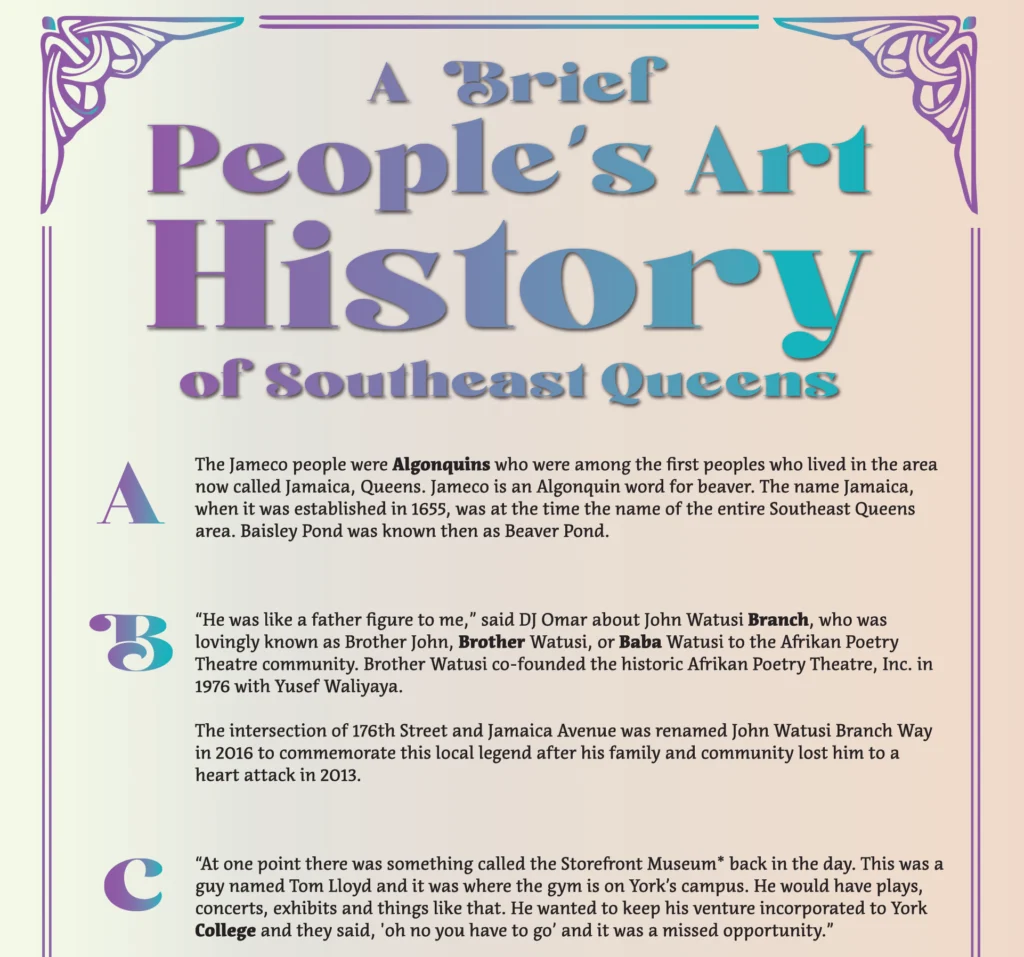
Her artist book A Brief People’s Art History of Southeast Queens extends this commitment to accessibility and multiplicity. What began as a collage project expanded into a written history based on interviews with local artists, and later into a documentary film. For Abrams, this evolution reflects a broader understanding of making: research, reading, and community engagement are not preliminary steps but integral parts of the artistic process. Each format, whether book, film, or collage, reaches different audiences, from academic institutions to local community spaces.
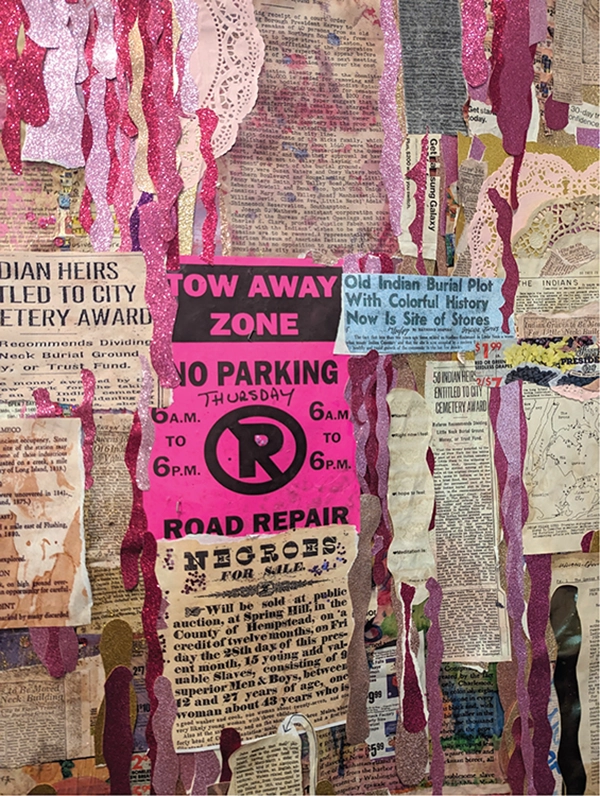
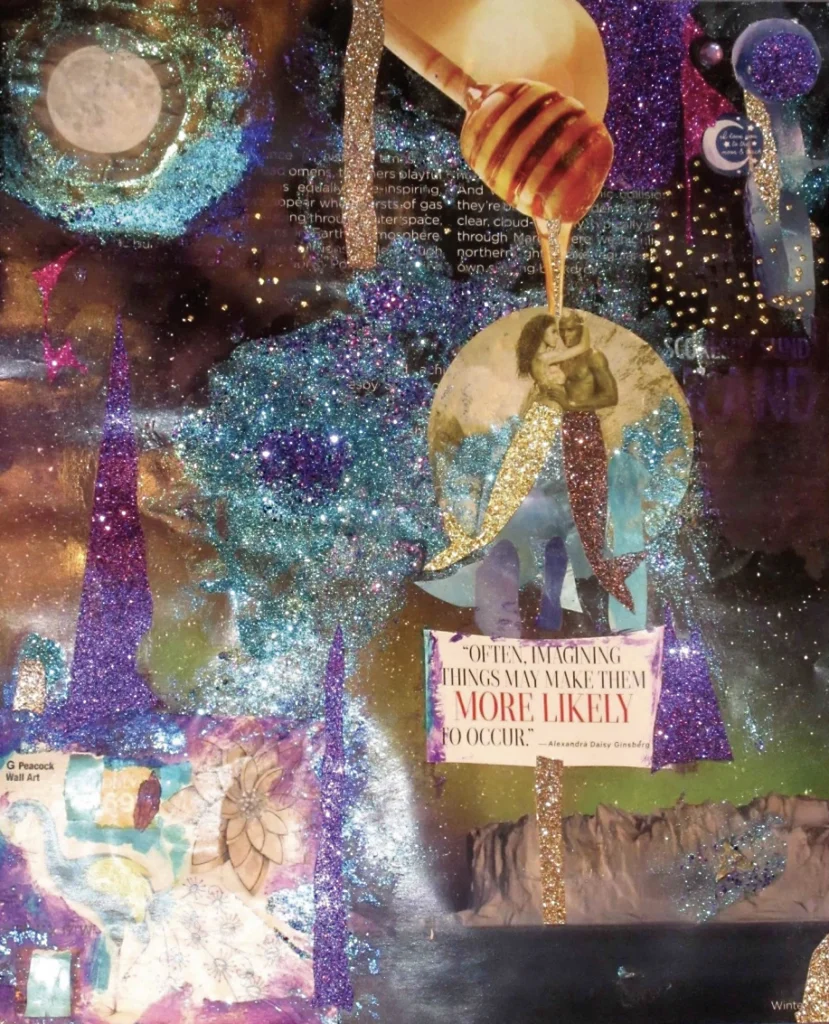
“A lot of my recent work is about activating archives,” Abrams explains. Rather than leaving historical materials confined to institutions, she integrates them into visual and tactile forms. In her collages, archival fragments such as texts, diagrams, and ephemera are embedded directly into the imagery, collapsing the distance between research and aesthetic experience. This approach responds to a practical concern: many viewers do not engage with supplementary materials like wall texts in gallery settings. By placing information within the artwork itself, Abrams invites viewers to encounter history as part of the visual experience, not separate from it.
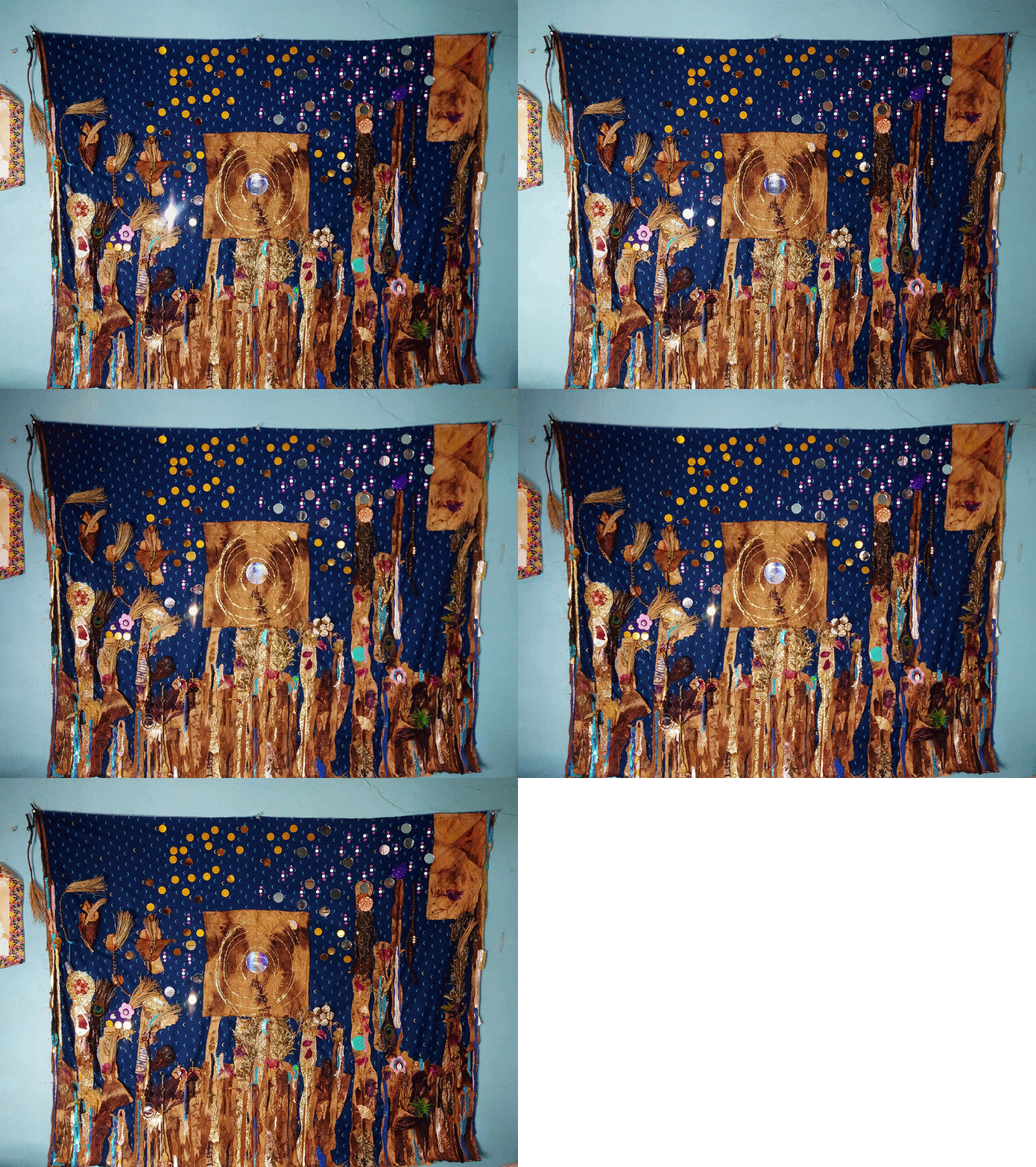
Full scroll view:
https://wsworkshop.org/wp-content/uploads/collection-item/a-brief-peoples-art-history-of-southeast-queens/png/ABriefPeoplesHistoryFull.png

This methodology is evident in works like From Genocide to Gentrification, which addresses the forced removal of a Native cemetery in Queens due to urban development. By incorporating contemporary reporting and historical context into the composition, Abrams insists on the continuity of dispossession, refusing to frame such events as distant or resolved.
Zines play a central role in this ecosystem. Abrams describes them as “democratic multiples,” emphasizing their affordability, portability, and immediacy. Unlike traditional gallery-based work, zines circulate hand-to-hand, allowing stories and histories to reach audiences who may never enter formal art spaces. Her current projects include a zine on the Underground Railroad in Queens, supported by a Queens Arts Fund grant, the city program administered by NYFA, as well as an organization-in-residence project on Governors Island, developed with the Southeast Queens Artist Alliance, that will include exhibitions, workshops, and space for people to gather around art.
Alongside this archival focus, Abrams’s practice is shaped by the conceptual framework of the Glitter Priestess. This viewpoint is not branding but a philosophy: an approach to art-making that draws from traditions of healing, ritual, and embodied knowledge. Influenced by her research into ancient priestesses, Abrams understands creative work as a means of creating spaces for restoration and connection, using whatever tools are available, whether visual art, conversation, beauty, or gathering.
Glitter, shimmer, and adornment are central to this language. Rooted in personal memory and familial associations, these elements carry emotional and cultural significance. Abrams challenges the tendency to dismiss such aesthetics as superficial, instead framing them as vessels for endurance, intimacy, and diasporic memory. In her work, beauty is not separate from political inquiry but intertwined with it.
This reading has begun to reappear in scholarly writing about her work. In a recent review, the writer and historian Genevieve Hyacinthe names a “Yamayan shimmer” in Abrams’s Untitled Mercouple, linking the work to Ana Mendieta, an artist Abrams cites as a central influence. Abrams welcomes how such criticism returns glitter and shine to seriousness. “Glitter and shine can be written off as something so decorative, something so feminine, something so unserious,” she observes. “And I do not accept that hierarchy. Shimmer can hold so much. Endurance. Intimacy. Transcendence. Black diasporic memory.”
“Pleasure matters. Beauty matters,” Abrams insists. For her, these are not luxuries but necessary conditions for survival and imagination. Even when engaging with histories of violence and erasure, her work creates space for joy, sensuality, and rest. This balance allows difficult knowledge to be held without overwhelming the viewer, while affirming the presence and resilience of Black and Indigenous communities.
Ultimately, Abrams’s practice invites audiences to reconsider what archives can be: not static repositories, but living, evolving sources of knowledge embedded in everyday life. Through her work, local history becomes essential rather than peripheral, and art becomes a space where research, memory, and healing converge.
BIO
Damali Abrams, also known as the Glitter Priestess, is a New York City–based artist and educator working across collage, video, artist books, zines, and community engagement. She is a member of the Southeast Queens Artist Alliance and has held fellowships with Culture Push, the Robert Blackburn Printmaking Workshop, A.I.R. Gallery, and apexart in Seoul. Her artist book A Brief People’s Art History of Southeast Queens (Women’s Studio Workshop, 2021) is held in the collections of Harvard University, Yale University, MIT, and the Library of Congress. Abrams attended the Whitney Independent Study Program and holds an MFA from Vermont College of Fine Arts and a BA from New York University. Her work can be found at damaliabramsart.com and on Instagram and TikTok @glitter_priestess.
0 Comments