
Written by Anne Swartz | Edited by Karin Luner
Anne Swartz is an art historian and professor of art history at the Savannah College of Art and Design, where she has taught since 1994. Her scholarship centers on feminist art, critical theory, and contemporary art, including art and technology and disability aesthetics. She is a scholar of Pattern and Decoration, the American art movement of the mid-70s to mid-80s. She curated Pattern and Decoration: An Ideal Vision in American Art, 1975-1985 at the Hudson River Museum in 2007 and 2008, and directed the two-part documentary Pattern and Decoration: Looking Beyond Formalism (Part I, 1998-1999, and Part II, 2018). She chaired the Honors Awards for the Women's Caucus for Art from 2006 to 2011. She was a Fulbright Scholar in Tokyo from 2002 to 2003.
More at anneswartzblog.org and on LinkedIn.
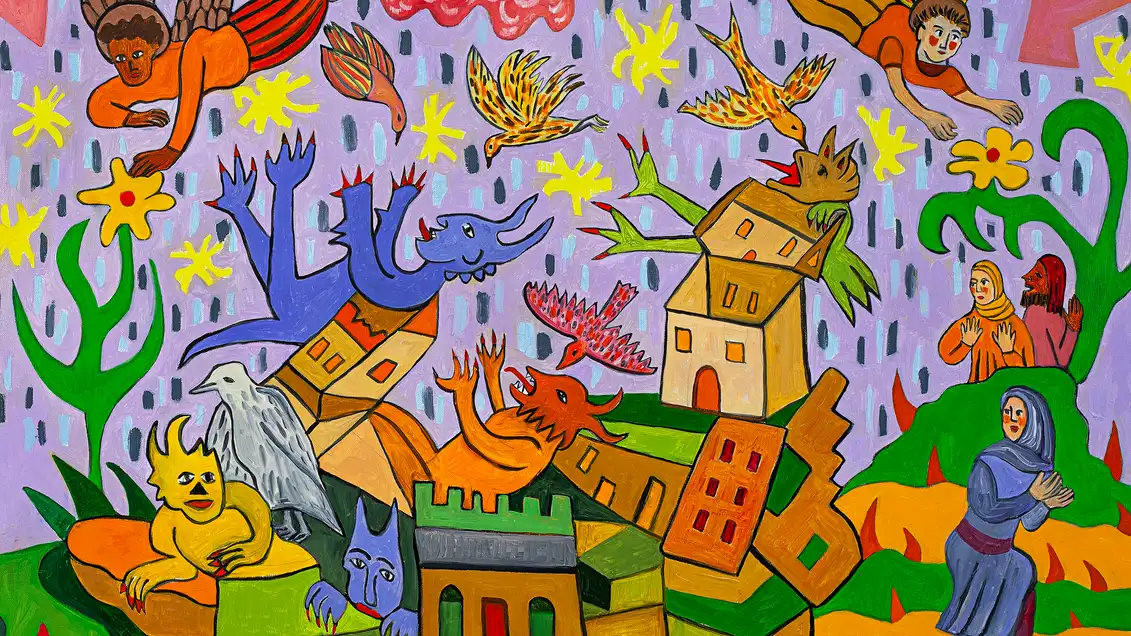
Banner image: Susan Bee. Days of Awe. 2023. Oil on linen, 30 x 40".
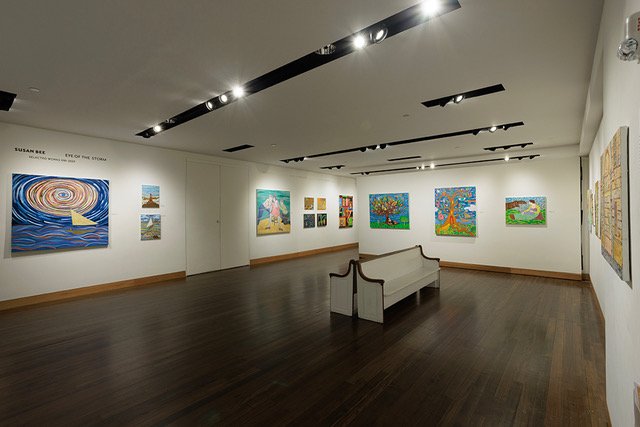
A visitor to the exhibition Susan Bee: Eye of the Storm, Selected Works 1981-2023 at the Provincetown Art Association and Museum in 2024 encountered more than forty years of Susan Bee's work at once. The survey was her first. She was seventy-two.
The delay is hard to explain as a reflection of achievement alone. Bee's work sits in major museums and research libraries. She received a Guggenheim Fellowship in 2014. She has shown steadily for decades while producing paintings, artist's books, criticism, and collaborative projects. The more revealing question is not why the survey came so late. It is what her career shows about how feminist art history remembers itself.
Feminist art history often gravitates toward origins. It returns to founding exhibitions, founding institutions, founding generations.
A.I.R. Gallery, short for Artists in Residence, sits at the center of that story as the first women's cooperative gallery in the United States. Yet institutions do not survive because they are founded. They survive because people continue the work after the founding moment passes.
Bee joined A.I.R. in 1997. By then the gallery's place in history was secure. Its future was not. The curator and historian Kat Griefen argues that the gallery's later decades deserve more attention than they have received, since they trace how feminist institutions survived after the energy of the 1970s dissipated. Bee puts it more plainly. "We were the ones who kept the flame going when the older generation left," she told me when I recently spoke with her about her work.
The claim serves the people who make it. Every generation rewrites the history it inherits. Still, Bee names a real gap. Histories celebrate the people who start institutions and pay less attention to the people who keep them alive. The distinction matters, because the work of continuing rarely makes the dramatic story historians prefer.
The same pattern runs through Bee's own career. In 1986 she and Mira Schor founded M/E/A/N/I/N/G, a journal that became an important forum for artists' writing and criticism. It gave artists a place to take up motherhood, aging, racism, artistic labor, and figurative painting at a time when mainstream criticism pushed those subjects to the margin. The journal did more than record a community. It helped build and hold one. Bee's life in art has meant more than making paintings. It has meant making the conditions in which other artists could think, write, argue, and publish.
Bee’s paintings work the same way. Bee often returns to images that carry long histories. Medieval manuscripts, Christian saints, Hudson River landscapes, German Romanticism, Jewish visual culture, and folk traditions all enter her work. She rarely treats these sources as symbols and images to preserve. She changes them.

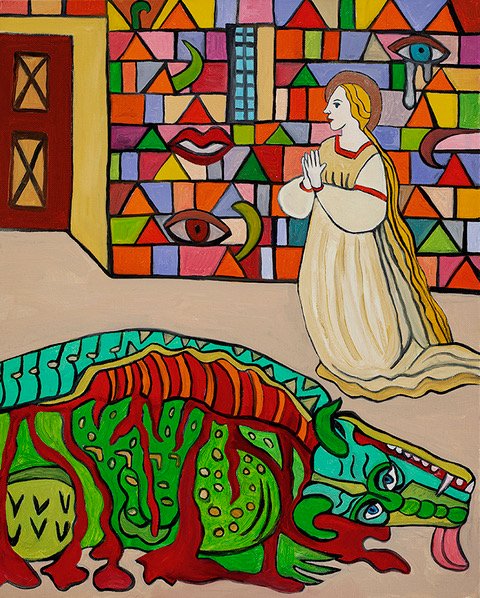
Saint Margaret and the Dragon from 2022 shows the method. Drawn from a medieval illumination in a prayer book, the painting keeps the shape of the old story but moves its emotional center. Margaret steps from the dragon's body in triumph, yet the dragon takes as much of the eye as the saint. Bee does not reverse the inherited narrative. She changes how the viewer stands in relation to it. Importantly, Saint Margaret is the patron saint of pregnant women and women in labor. In the painting, the prison wall enclosing her is animated and contains an observant eye, mouth, and ear. The same move recurs across her work. Figures once cast as monstrous, marginal, or defeated become objects of sympathy.
A distinctive handling of the surface drives these shifts. Bee draws with a heavy line, presses her objects to the front of the picture plane, and keeps the mood sunny even when the subject is doom. The space stays shallow. The color stays loud. The logic elides between folk art and the easel tradition she revises. She uses little white, which keeps the color dense. Her saturated, near-vibrating color recalls Pierre Bonnard, whose interiors and gardens flare into chromatic events.
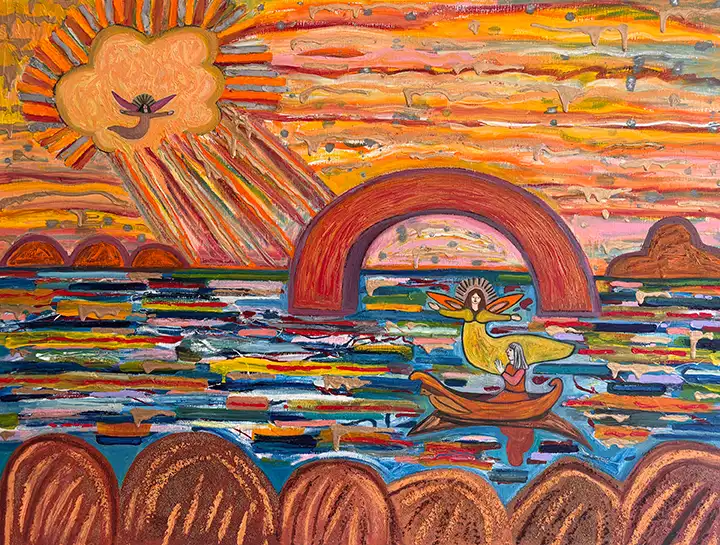
The same brightness lights her darkest subjects. One room of the survey held apocalypse paintings drawn from a medieval French manuscript, their seven-headed dragons and praying crowds rendered in shining color and studded with gold and neon polka dots. The doom is real. So is the merriment. Bee made the work during the pandemic and the first Trump administration, isolated, painting to steady herself. The strategy has a long lineage, and she claims it directly. Persecuted Jewish communities painted their wooden synagogues with lions and serpents and constellations and laughed at their enemies through the dark comedy of the Purim play. Bee descends from a Torah scribe, from a tradition wary of graven images, and she makes images anyway, trading the saints' crosses for flowers and moving their feminine power into a secular key. The color is not decoration laid over dread. The color is the argument with dread.
Bee calls her pull toward color and pattern a matter of disposition. She took her master's at Hunter College, where the program belonged to the male minimalists and Robert Morris taught her to use the grid. "I think it's a temperament," she said when I asked about the maximalism that broke with that training. The answer is true but partial. She came up when many women artists were looking for ways out of modernist reduction and purity. Pattern and Decoration offered one route. Bee took its color and ornament and kept narrative, which set her apart from its other practitioners.
That difference shows most in how she handles decoration. Asked whether ornament still carries a political charge, Bee answered, "No, I wish it did." The disappointment matters. By the time she matured as a painter, earlier feminists had already won the case for ornament. She did not need to defend it. She used it. In her hands, ornament holds stories, memories, fears, and desires. It works less as an argument than as a language.
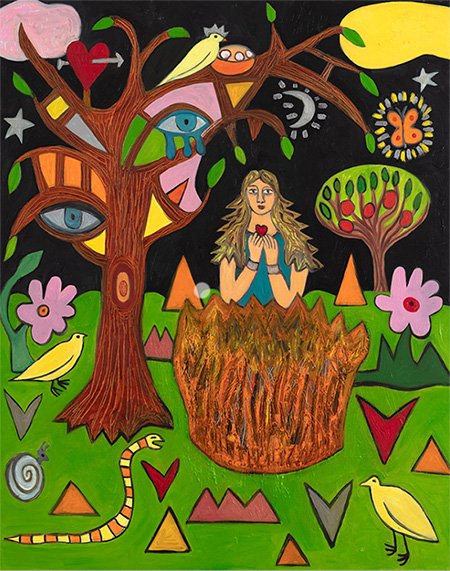
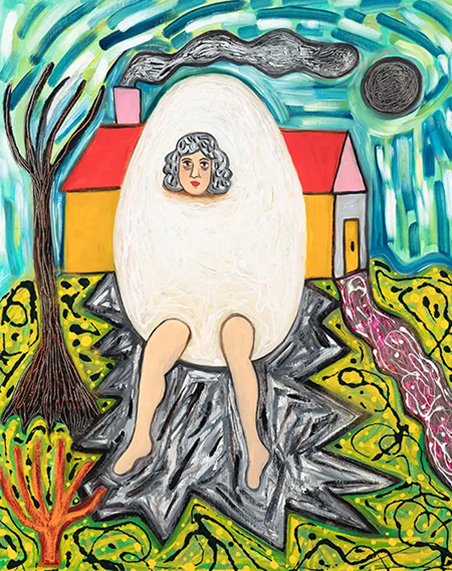
Collection: Jane Malcolm
Bee has stayed at A.I.R. since 1997 because the cooperative gallery will not tell her what to paint and show. She has joined commercial galleries several times, and they tend to close soon after she arrives. She calls herself “the closer.” This freedom carries a price. She does the legwork for her own shows and goes without a dealer's push into museums. The model did not protect everyone equally. Harmony Hammond, a founding member of the gallery, built a commercial career and found that sales did not buy the freedom the cooperative had given. Bee kept the freedom and has paid in money and in canonical standing. The reception compounded the cost. The word that attaches to her is “whimsical.”
The reception shows how hard her work is to name. Raphael Rubinstein, an admirer who later contributed to the survey catalog, called her collage elements “whimsical” in Art in America in 2011. The word catches something real. Her work has humor, fantasy, and play. Yet its staying power raises a question about the vocabulary critics use for artists who fold together ornament, quotation, narrative, and pleasure. Whimsy can become a way to grant complexity and shrink it in the same breath.
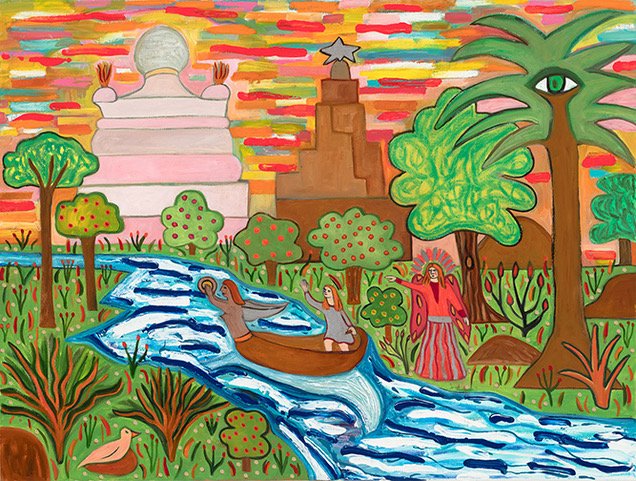
Questions of appropriation come from the same habits, and they do not weigh the same. Bee repaints two Romantic landscape painters, the American Thomas Cole and the German Caspar David Friedrich, both from traditions built to keep women out and both fair for her to claim. She has remade Cole's series of four paintings of The Voyage of Life with women in place of the male protagonists, and now that she lives by the river, she takes the lineage for herself. "I've decided I'm a Hudson River painter," she says. She paints after Friedrich too. When German academics told her she could not, because the Nazis had claimed him, she answered that he died in 1840, decades before the regime that adopted him. The objection is not frivolous. National Socialist aesthetics did pull Friedrich into a politics of blood and soil, and that reception clings to the work. Bee paints through it, despite being a Jewish artist. Reworking a hostile Western canon is a fair move, since it was built to exclude her.
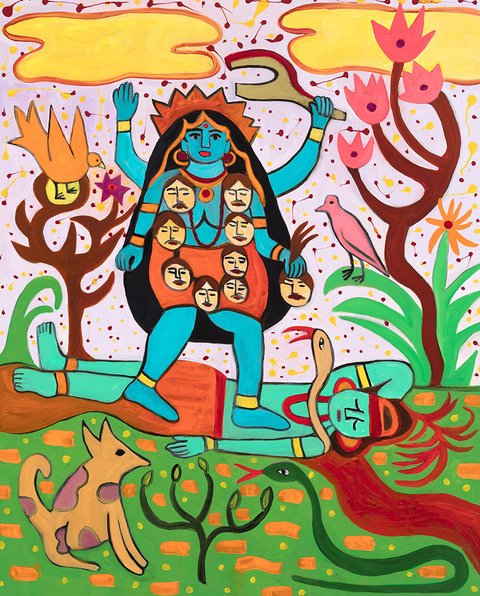
The goddesses are a different matter. Bee also paints Kali and Durga, two Hindu goddesses she came to after two trips to India, a Jewish American artist taking up deities she does not worship. She was in Tamil Nadu in southern India and in Sri Lanka on one trip. Then she went to Mumbai and Rajasthan on a second trip. Both trips were with Edward Rothfarb, an art historian and visual artist, whose historical research focuses on architecture and painting in South Asia. Interestingly, she gave a talk about her paintings in Mumbai to a local art and poetry audience and they appreciated her work. The colorful nature of it and the medieval beasts really appealed to them.
Kali is the goddess of destruction and time, garlanded in severed heads. Durga rides a lion and slays the buffalo demon. Both remain living objects of worship. To ask what their imagery can do for a painting is to treat devotion as a store of charge on which to draw. Hindu and South Asian feminist critics have long contested that move, the use of living deities as a resource for any artist who finds them striking. The Jewish inheritance Bee draws on elsewhere, with its own history of persecution, reads here as access rather than vulnerability, the freedom of a New York artist who can take up Kali on one visit and carry her home. Bee does not resolve the tension.
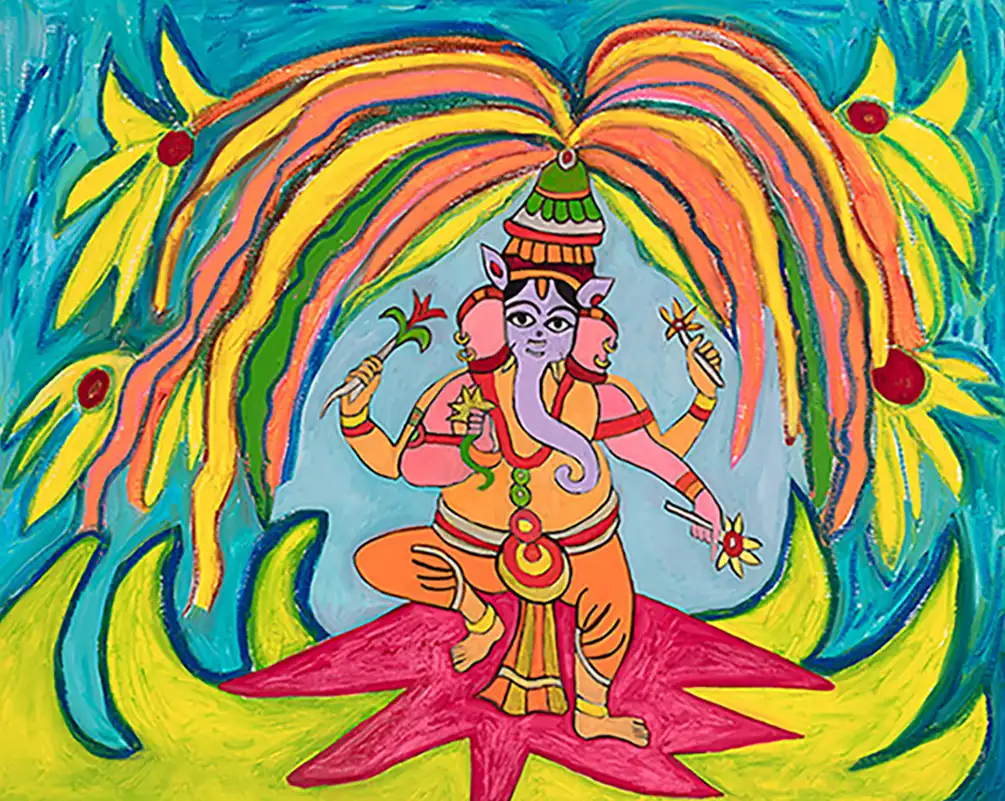
Rather than explain the contradiction away, Bee leaves it in view. Her paintings do not settle the questions they raise. They expose them. The habit defines her practice. Again and again she chooses engagement over purity, entering old stories, images, and traditions that arrive loaded with histories she cannot fully control.
Seen this way, Eye of the Storm did more than gather four decades of work. It surfaced links that are hard to see when the paintings hang apart. It made plain how steadily Bee has returned to inherited images and remade them. And it lit up a career built not only on making but on decades of editorial, institutional, and collaborative labor.
More than that, the survey exposed a gap in the story feminist art history tells about itself. Founders stay central to that story, and rightly so. Yet Bee's career argues that the history of feminist art cannot rest on beginnings alone. Institutions survive because someone continues the work after the founding moment passes. Publications survive because someone keeps editing, writing, and organizing. Communities survive because someone stays when the first excitement fades.
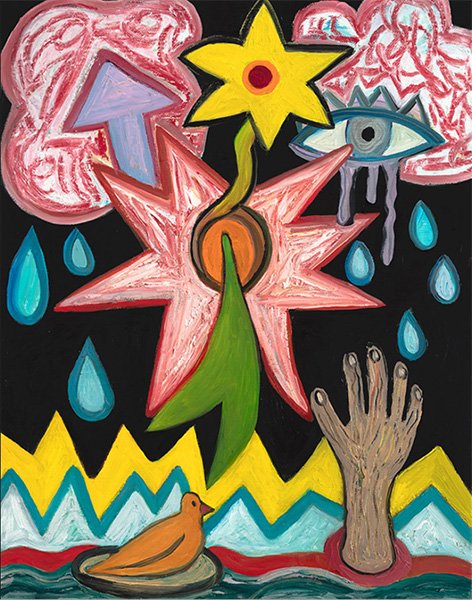
Near the end of our talk, Bee gave a plainer reason for lasting. What keeps her working, she said, is "just the desire to create." The line catches what the paintings already show. Yet Eye of the Storm told a larger story too. Bee's career makes visible a kind of labor that usually drops out of the record. The survey reveals not only the scope of an artist's accomplishments. It also shows how much of feminist culture rests on the people who carry it forward.

Susan Bee's work is held in the collections of the Metropolitan Museum of Art, the J. Paul Getty Museum, the Victoria and Albert Museum, the Clark Art Institute, the New York Public Library, the Bibliothèque nationale de France, and the libraries of Yale and Harvard, among others. Her artist's book archive and the M/E/A/N/I/N/G archive are held at the Beinecke Rare Book and Manuscript Library at Yale. She received a Guggenheim Fellowship in 2014 and has held fellowships at MacDowell, Yaddo, and the Virginia Center for the Creative Arts. With Mira Schor she co-edited M/E/A/N/I/N/G: An Anthology of Artist's Writings, Theory, and Criticism, published by Duke University Press in 2000. She has been a member of A.I.R. Gallery since 1997, where her recent solo exhibitions include Days of Awe: New Paintings, 2025.
Susan Bee: Eye of the Storm, Selected Works 1981-2023, her first museum survey, was curated by Johanna Drucker at the Provincetown Art Association and Museum in 2024, with a catalog of essays by Drucker, John Yau, and Raphael Rubinstein. More information is available through A.I.R. Gallery and the artist's website.
Profound insights into your work and the ability to remain on your own track. The paintings have become exceedingly richer and more inclusive without sacrificing your initial trajectory.
Dear Charles, Thanks for your thoughtful response. Much appreciated. Susan Bee